
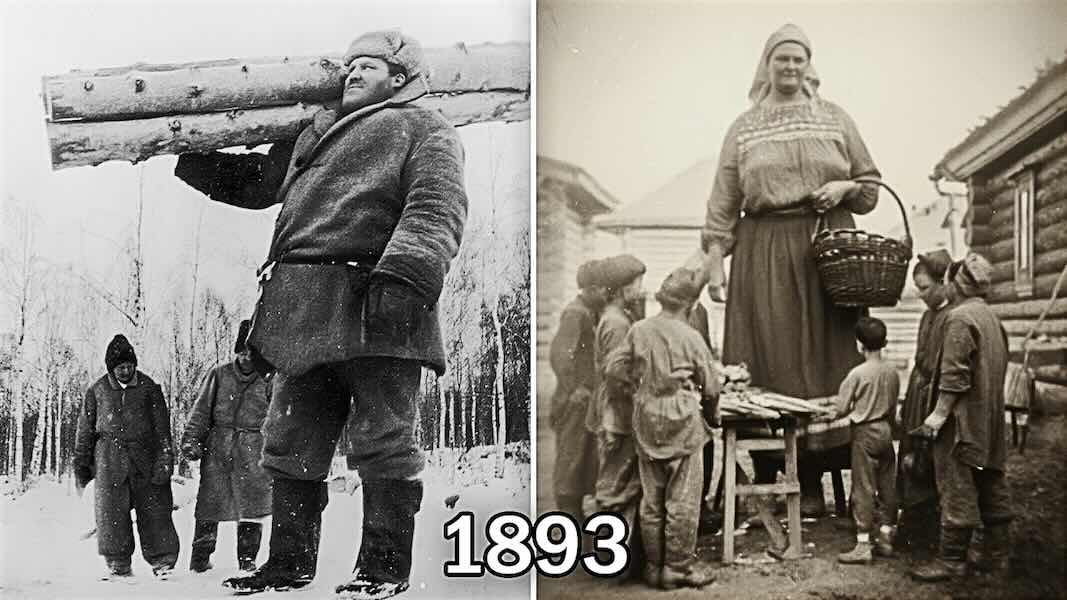
Why do dozens of photographs from the 1880s through early 1910s show Siberian logging crews containing human beings of impossible scale—nine, ten, sometimes eleven feet tall—standing alongside normal-sized workers in frozen forests with equipment and structures that match their proportions? Across Siberian Russia, the Russian Far East, and northern territories, archival images preserve individuals whose very existence challenges everything we’ve been taught about industrial labor history, positioned with work crews operating massive saws, transport sleds, and logging camps with architectural features sized precisely to their frames.
As I examined Russian state archives, French expedition records, and Swedish logging company photographs from the late 1800s, a repeating pattern emerged: giants documented as valued workers performing heavy timber labor, tools and equipment scaled beyond normal human capacity, and documentation that ceased abruptly after 1912. These weren’t medical curiosities or isolated anomalies—they were documentary evidence of a worker population that existed routinely, matter-of-factly, then systematically erased from the historical record.
This investigation explores the Siberian giant workforce theory—the extraordinary individuals who may have powered the region’s massive timber operations, the coordinated archival erasure, and the physical evidence still visible in photographs, abandoned tools, and camp structures throughout the taiga. The deeper we examine the record, the harder it becomes to believe these individuals were random anomalies rather than functional members of an industrial workforce.