

By James Corbett on December 14, 2025
Remember when I wrote about the Dead Internet Theory? You know, the idea that most of what we see, read and hear on the internet is bot-generated?
Well, guess what? That theory has been confirmed! Everyone you talk to online is a bot, spy, troll or psyops warrior!
And, as you’re about to see, it gets even worse before it gets (hopefully) better.
Intrigued? Want to know what this means for the future of the internet? Or, much more importantly, what it means for the future of human community? Then read on!
FOREIGN SPIES UNMASKED
If you’ve been “surfing the web” since the early days of the “information superhighway,” you’ll no doubt recall one of the earliest online jokes: “On the internet, nobody knows you’re a dog.”

Now, in 2025, it seems we may need to amend that joke to take it from a pithy observation about online anonymity to a dire warning about the weaponization of online anonymity: “On the internet, no one knows you’re a foreign psyops officer.”
You see, last month the social media platform formerly known as Twitter decided to roll out a new feature: a location tool that reveals the country or region in which a given account is based. The result? A lot of foreign psyops warriors got caught with their pants down.
@MagaNationX?
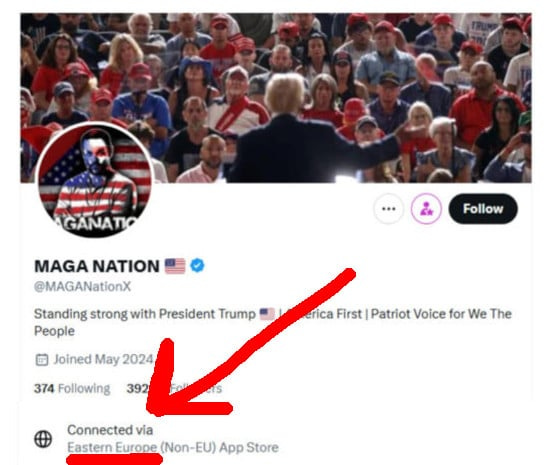
…Turns out that account is actually based in Eastern Europe.
And the @IvankaNews Ivanka Trump fan account?
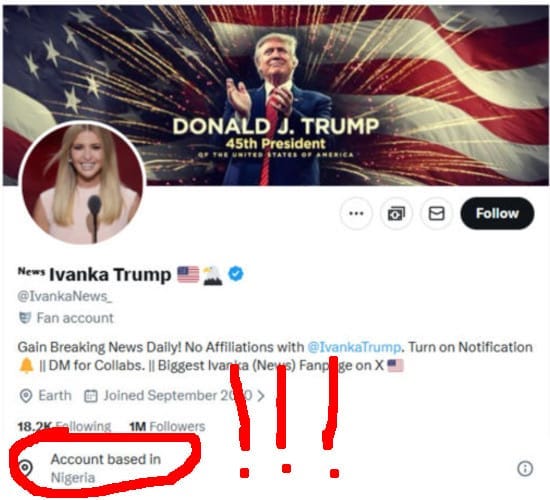
It seems that particular Trump-loving Ivanka fan is based in the MAGA stronghold of . . . NigeriaAnd it’s not just those accounts. The @BarronTNews_ Barron Trump fan account (that posted heartfelt birthday messages to “Dad” Donald before it was exposed as a fan account)? The “UltraMAGA Trump 2028” account? Those accounts and numerous others were discovered to be originating from similarly far-flung corners of the globe.
You can imagine the field day that headline writers of the dinosaur legacy media had with these revelations:
- X’s new feature raises questions about the foreign origins of some popular US political accounts;
- Has X’s new location feature just exposed MAGA influencers as foreign trolls?;
- New X Feature Reveals Top MAGA Accounts Based Overseas;
Indeed, it seems every online outlet was able to find examples of their ideological enemies being exposed as foreign agents.
Israeli outlet ynetnews, for example, is reporting that the X location feature has unmasked a “fake Gaza influencer network” with accounts purporting to be of Gazans under attack that actually originate from Malaysia, Afghanistan, Pakistan and other distinctly non-Gazan locales.
Some users protested their geographic identification or added context to their apparent location. The @1776General_ account, claiming to be “Constitutionalist, Patriot 🇺🇸, Ethnically American” but found to be “based in Turkey,” countered with a post noting: “I work in international business. I’m currently working in Turkey on a contract.”
Remarkably, even the US Department of Homeland Security had to tweet a reassurance that it is, in fact, American, after apparently doctored screenshots circulated suggesting the account was based in a foreign country.
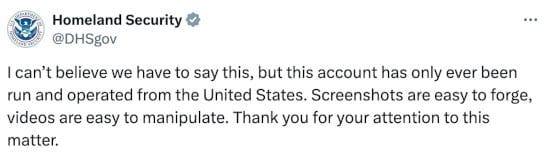
X, for its part, attempted damage control over the incident—advising users that “its new feature could be partially spoofed by using a VPN to mask a user’s true location”—before removing the location information altogether.
And so The Day The Foreign Spies Were Unmasked came and went. For one brief moment, people were reminded of one of the fundamental lessons of the internet: you have no idea who (or what) you are “talking to” in online conversation.
Perhaps the account feeding you a “first person” tale of some breaking news event or “on-the-ground” analysis of a military conflict actually is whoever they’re claiming to be. Or perhaps they’re a dog. But it’s certainly possible they’re a foreign agent attempting to influence your opinion by feeding you fake, misleading or selective information.
This should not be news to anyone who has been paying attention.
Long-time Corbetteers will recall my 2018 report on The Weaponization of Social Media, in which I reported that:
- the Pentagon was “buying software that will enable the American military to create and control fake online personas—fake people, essentially—who will appear to have originated from all over the world”;
- government-owned computers at the Army Corps of Engineers offices in New Orleans were caught verbally attacking critics of the Corps;
- Israeli groups were giving courses on how to edit Wikipedia articles to ensure content on the online encyclopedia remains “Zionist in nature”; and
- an internal document from the GCHQ—Britain’s NSA equivalent—had been leaked, exposing that the British spies were using social media platforms to spread propaganda and influence public opinion.
And that was seven years ago. Imagine how much worse things have gotten since then, after the Q Anonsense psyop and the advent of the 77th Brigade and the takeover of every major social media platform by “ex”-intelligence officials.
Yes, it’s no surprise to anyone in the conspiracy realist community that the internet is flooded with spies who are actively attempting to mislead you.
But wait, it gets worse!
CLANKERS DEPLOYED, TROLLS UNLEASHED
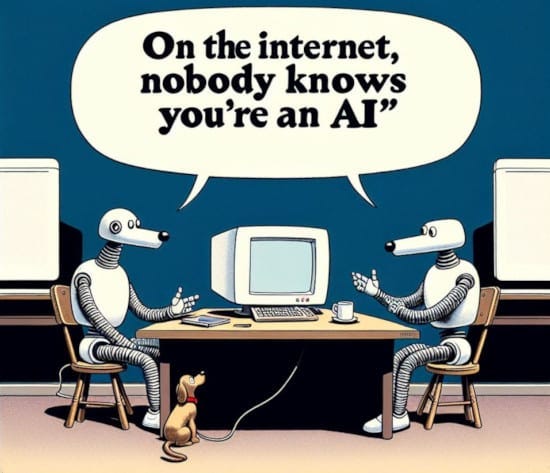
Why assume that the account you’re interacting with is human—or even canine? As chatbot technology advances, it’s increasingly likely that you’re talking to a machine.
I’m not talking out of my posterior here. I’m talking statistically.
You might not have caught this story when it flitted through the newswires earlier this year, but it’s confirmed: bots now account for over half of all internet traffic.
That is the alarming (but hardly surprising) conclusion of the Imperva Bad Bot Report, an annual assessment of bot activity on the internet by cybersecurity company Imperva. This year’s report found that not only do “bots”—that is, automated programs running tasks on the internet—now account for 51% of all online traffic but that 72% of that bot activity is malicious.
Once again, this is not news to those paying attention. Indeed, as I observed in my “The Internet is Dead“ editorial two years ago:
If this theory [i.e., the Dead Internet Theory] is correct, then the computer-created content of the dead internet includes not just the obviously inhuman content on the web—the spam that overruns every unmoderated comment section, for instance, or the botnets that flood social media with identically worded propaganda posts—but everything: the content itself, the commentary on that content, the “people” we interact with online, even audio podcasts and video vlogs and other seemingly human-generated media.
While the concept of a bot-dominated internet might have seemed outlandish when the theory was first floated, it is decidedly less outlandish in this age of Sora video slop and AI news article slop and AI scientific paper slop and AI podcast slop. After encountering the Facebook Shrimp Jesus phenomenon, who can doubt that the web is increasingly populated by bots posting AI-generated content for consumption by other clankers in some sort of snake-eating-its-own-slop version of the internet that only makes sense to the likes of Zuckerberg and Musk?
But wait, it gets even worse!!!
Not only do the average Joe and average Jane have to contend with the online spooks, spies and cyberwarriors pumping propaganda out in furtherance of their paymasters’ and string-pullers’ nefarious agendas, and not only do they have to sift through the mounds of AI slop to find genuine human interaction online, but they also have to deal with the trolls who are there to poison that human interaction “for the lulz.”
Anyone who has spent time in the comments section of a website, or, increasingly, in discussion on a social media platform, knows exactly why the term “rage bait” has been chosen as Oxford’s word of the year for 2025. As every netizen is all too aware, these days any online conversation with enough participation to be interesting is inevitably dominated by the lowest common denominator of loud, obnoxious and boorish behaviour.
But the trolls are a different breed altogether. They set rage bait and spew bad faith arguments online as a way of (at best) venting their anti-social tendencies in an environment where they won’t be punched in the face and (at worst) deliberately steering online conversation away from productive topics.
In the course of my research, I sometimes come across old school online fora and other long-forgotten parts of the web showcasing how online discussions unfolded twenty or more years ago, before the advent of social media. The difference between those discussions and what passes for online discourse today is never less than breathtaking. You can witness people of a bygone internet era having in-depth discussions, sometimes on important political or social matters upon which the posters fundamentally disagree. But, unlike anything you’d see today, these online debaters of yore not only spent time articulating their viewpoint and how they arrived at it, they actually listened to their interlocutors and (gasp!) engaged them in good faith. Sometimes, they even conceded points or agreed to disagree.
The fact that such fruitful online discourse is now a thing of the past is, obviously, something to lament. But what makes it even worse is that the types of toxic rage-inducing flamewars that pass for online discourse these days are now starting to manifest in the real world. An entire generation of young people who have grown up primarily online and in internet trolling culture have been socialized into thinking that this is what natural human discussion is. They are now reflecting that attitude in their everyday, offline, “IRL” behaviour, leading to the breakdown of social mores we see around us today.
In other words, the dead internet is leaking.
Yes, as we’ve seen, things are going from bad (the online spies and cyberwarriors) to worse (the AI slop of today’s web) to even worse (the trolls who are threatening to tear apart the very fabric of society).
But here’s the real question: does it get better?
WHAT IT MEANS

As usual, the answer to that question is what we make of it.
Sure, there are things we can do to make the online world slightly more human (in the good sense).
You can avoid the spies and trolls and cyberwarriors (at least for the most part) by avoiding the major social media platforms altogether and participating in discussion in more elite circles (like the comment section of corbettreport.com, to take one completely random example).
You can take greater control of your online life by using RSS instead of allowing algorithms to determine what you’ll read or watch or listen to next.
Heck, there’s even a new “Slop Evader“ browser extension you can install that promises to help you explore the pre-AI slop internet by searching for content from before ChatGPT was unleashed on the world. (Although, as even its creator notes, this extension is just a simple date filter for Google search results and thus not a fundamental solution to the crisis.)
But perhaps the real solution to this bot-generated, spook-propagated, troll-inflamed Dead Internet emergency is not to be found online at all. Perhaps the real solution is to be found in actual human community. In real people coming together in the real world to reconnect with what is really human.
Yes, that seems like a pie-in-the-sky fantasy in today’s online world, doesn’t it? But if we can’t even dream it we’ll surely never achieve it.