

By Died Suddenly News on May 16, 2026
A growing debate over the foundations of virology is drawing renewed attention online after a recent report highlighted a legal and scientific challenge in India questioning whether viruses have ever been conclusively proven to exist through direct isolation and purification methods.
The controversy was recently discussed by Dr. Sam Bailey, who covered an ongoing court-related dispute in India centered around the standards used to identify and characterize viruses.
Critics involved in the debate argue that modern virology relies too heavily on indirect laboratory methods rather than directly isolating alleged viral particles from bodily fluids in the way many people assume.
According to a recent report, the case has become part of a larger international conversation surrounding virology, infectious disease theory, and the scientific methods used to identify pathogens.
At the center of the debate is a question critics say has never been adequately answered: if viruses are responsible for contagious illnesses and are present in large quantities inside infected people, why can they not simply be directly isolated, purified, photographed, genetically sequenced, and demonstrated from human fluids alone without the use of complex cell culture systems?
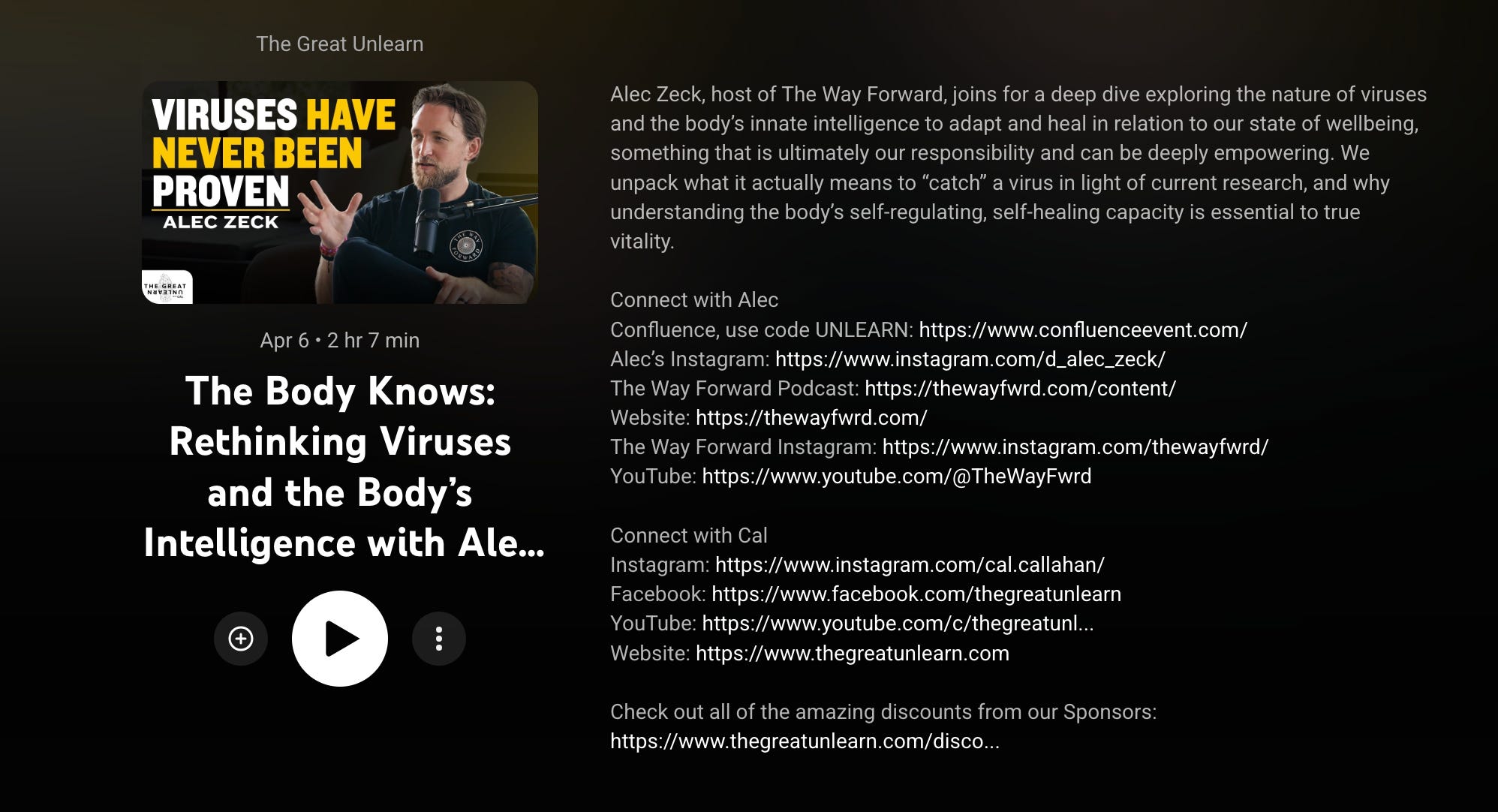
That argument was recently expanded on during a podcast discussion that has circulated widely online. In the clip, influencer Alec Zeck challenged conventional virology by arguing that researchers cannot directly isolate viruses from the bodily fluids of sick patients in the way the public is often led to believe.
“When you simply ask virologists why can’t you isolate, purify, characterize and sequence the virus directly from the fluids of a sick person,” Zeck said, “they typically say the virus is too weak to isolate or purify directly from the fluids.”
Zeck argued that explanation creates what he described as a logical contradiction. If a virus is supposedly strong enough to survive on surfaces for days, invade human cells, hijack cellular machinery, replicate itself, and spread from person to person, critics question how it could simultaneously be “too weak” to directly isolate from bodily fluids.
Others involved in the debate argue that the methods used in virology often rely on cell cultures, chemical agents, genetic amplification, computer modeling, and indirect interpretation rather than extracting a complete viral particle directly from patient samples and demonstrating causation in a simple observable manner.
Zeck also challenged another commonly cited explanation — that insufficient quantities of virus are present in samples for direct purification. He pointed to studies and public health discussions that claim millions of viral particles can be expelled through coughing and sneezing.
“Anyone can Google this,” the speaker said. “How many virus particles are in one sneeze and cough? Some results will say 20 million, some results will say 200 million.”
Bailey also questioned long-standing assumptions surrounding measles, arguing that many illnesses historically blamed on viruses were later found to have entirely different causes.
She pointed to pellagra as one example — a disease once believed to be infectious before researchers discovered it was actually caused by a severe niacin (vitamin B3) deficiency. According to Bailey, vitamin deficiencies may play a much larger role in diseases associated with rashes and immune dysfunction than most people realize.
She specifically highlighted vitamin A deficiency in relation to measles, noting that vitamin A has long been associated with measles treatment and recovery. Bailey argued that mainstream explanations often assume the virus itself depletes vitamin A stores, rather than considering whether nutritional deficiencies may already exist beforehand.
She also referenced “morbilliform” rashes — skin eruptions that closely resemble measles but can be triggered by medications and other non-viral causes. Because these rashes can appear visually identical to measles, Bailey said it raises broader questions about how measles cases are defined and diagnosed, especially when many symptoms are considered non-specific.
Critics say that if such quantities truly exist inside bodily fluids, direct isolation should be straightforward. They argue that the inability to produce what they consider a clear purification process raises questions about the assumptions underlying modern virology.