Martin Geddes on Excavating the Rabbit Hole: how one undeniable Anomaly in the Midterm Elections could expose a hidden Structure of Power, Step by Step.
Excavating the Rabbit Hole by Martin Geddes
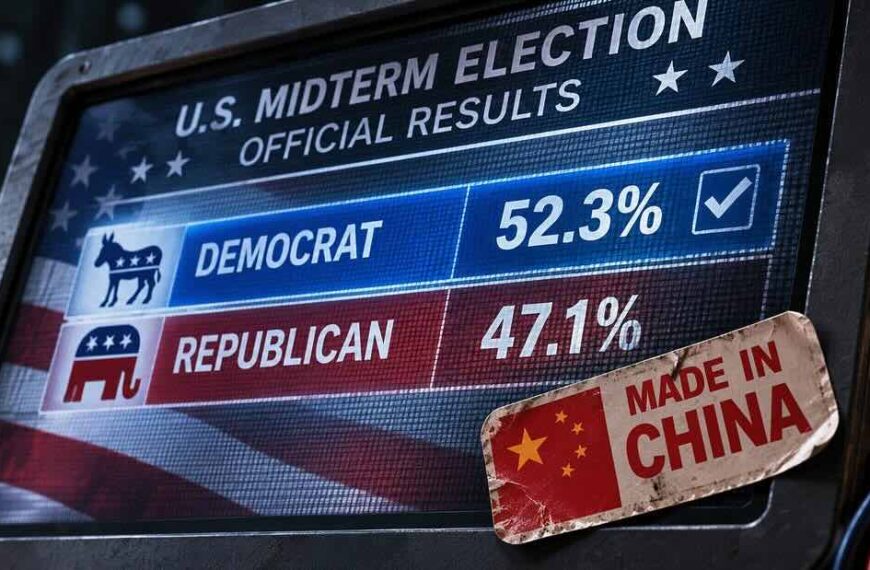
It appears we may be approaching the final stages of a long-running operation to expose the shadow government that Eisenhower and Kennedy warned about, each in his own fashion. My working hypothesis is that the American mid-term elections are part of a highly scripted and structured operation intended to initiate a visible “phase change” in the paradigm of governance. Whether that interpretation proves correct remains to be seen.
I want to explore something more subtle than the alleged election fraud itself: why the sequencing of revelations might matter as much as their content, and how exposing one relatively simple deception could initiate a chain reaction of public awareness that eventually reaches the entire hidden power structure.
The challenge is not merely to reveal what has happened. It is to create the conditions in which ordinary people can recognise it for themselves.
Perhaps the most interesting aspect of the election result is not the alleged cheating, but how commentators react to the possibility. There is a grab-bag of narrative “go to” talking points available to make the result mean whatever fits an existing worldview. You can cherry-pick data points, such as comparisons between the 2026 mid-terms and the 2024 presidential election, while ignoring wider anomalies, to support almost any preferred interpretation.
Some alternative-media commentators who ordinarily profess a commitment to exposing corruption appear remarkably incurious about allegations that ought to interest them. Whether this reflects ignorance, selective attention, political loyalty or something more deliberate is an open question. But the willingness to investigate uncomfortable evidence is itself revealing.
People with busy lives generally do not want to hear things that make them fearful and impotent. They are naturally attracted to explanations that preserve a sense of stability, familiarity and control. This makes them vulnerable to narratives that offer psychological comfort at the expense of uncomfortable inquiry.
A key challenge in exposing systemic election fraud, if it has occurred, is therefore to cut through the confusion and minimise the opportunities for narrative counter-attack, whether from declared opponents or supposed allies.
What follows is my own semi-speculative reconstruction of how such a process might work.
The importance of geometry
For the sake of argument, I am going to assume that a key piece of evidence eventually presented to the public involves military-grade watermarked ballot papers, or the absence thereof. This is a longstanding claim within the Q-related information environment, rather than an established fact about the 2026 election. I am using it here as a hypothetical mechanism through which an exposure operation might unfold.
The significance of physical ballot authentication is that it offers a potentially different kind of evidence from procedural cheating, such as unlawful voter registration, or algorithmic cheating, such as injecting false digital vote records and deleting genuine ones.
A piece of paper either possesses a particular physical mark or it does not. That is a geometric fact.
Of course, the absence of a mark only becomes evidence of fraud once the authentication scheme, its application to the ballots in question, and the provenance of those ballots have been established. But once those foundations are secure, the resulting discrepancy may be far easier for the public to understand than a complex statistical reconstruction.
Imagine ten million ballots that can be independently demonstrated not to have originated from the authorised printing and distribution process, yet were counted as legitimate votes. The scale and physical uniformity of the discrepancy would present an extraordinary problem for the official account.
The forensic conclusion would not require ordinary citizens to understand sophisticated algorithms or competing statistical models. They could see the physical discrepancy, understand its significance, and ask how it came about.
This distinction matters enormously.
In our Geometry–Topology–Field–Observability (GTFO) analytical framework, geometry concerns what can be directly established about the objects and relationships under examination. Topology concerns how those objects and events connect. Field concerns the organising forces, intentions and constraints that give those connections their wider significance. Observability concerns what can actually be known from the available evidence.
Algorithmic election fraud, by contrast, typically requires a motivated observer to assess large numbers of data points for patterns consistent with deliberate manipulation. No single statistical anomaly necessarily discredits the result. The connectedness of the discrepancies must be reconstructed, and their relationship to an alleged organising intent must then be evaluated.
You have to decide whether the scatter graph really says what someone claims it does.
A sufficiently well-authenticated physical discrepancy can shorten that journey. The geometry is accessible: you can physically hold a ballot paper up to the light to see whether the watermark is present. The topology of the immediate discrepancy is relatively simple: mass production of unauthorised ballots implies a hidden operational infrastructure somewhere, with the means to print, distribute and introduce them into the electoral process. None of this initially requires a comprehensive theory of the perpetrators’ identities or intentions.
If the watermarks are absent where they should be present, the physical anomaly is established. The wider explanation remains to be discovered.
The more interpretative steps required to recognise wrongdoing, the greater the opportunity to prevent public recognition of it.
That is why I suspect geometry may be the essential starting point.
Finding the entrance
Many of us have encountered anomalies in the world and subsequently embarked on a long journey of personal re-education. We have voluntarily explored the “rabbit hole”, often at considerable personal cost, with many false starts and mistaken interpretations along the way.
We did not necessarily begin with a grand theory of hidden power. We began with something that did not fit.
One anomaly led to another. Previously unrelated events acquired possible connections. Institutions we had trusted began to look different. Eventually, the structure of our understanding changed.
But this journey cannot simply be compressed into a presentation and delivered to millions of people who have not undertaken it.
Telling someone that their elections are rigged, their political leaders are controlled assets, their news media are propaganda instruments, and their institutions have been captured by organised crime is asking them to reconstruct almost their entire model of society in one step.
Even if substantial parts of such a claim were true, the psychological demand would be enormous.
It is understandable that people recoil from the possibility that they have been subjugated to hidden forces over which they have little control, and that their trust has been systematically abused. Accepting such a possibility can threaten their political identity, social relationships, professional standing and sense of personal agency.
The first step therefore needs to be something much more modest.
Not “the whole system is criminal”.
Just “this particular thing is not right”.
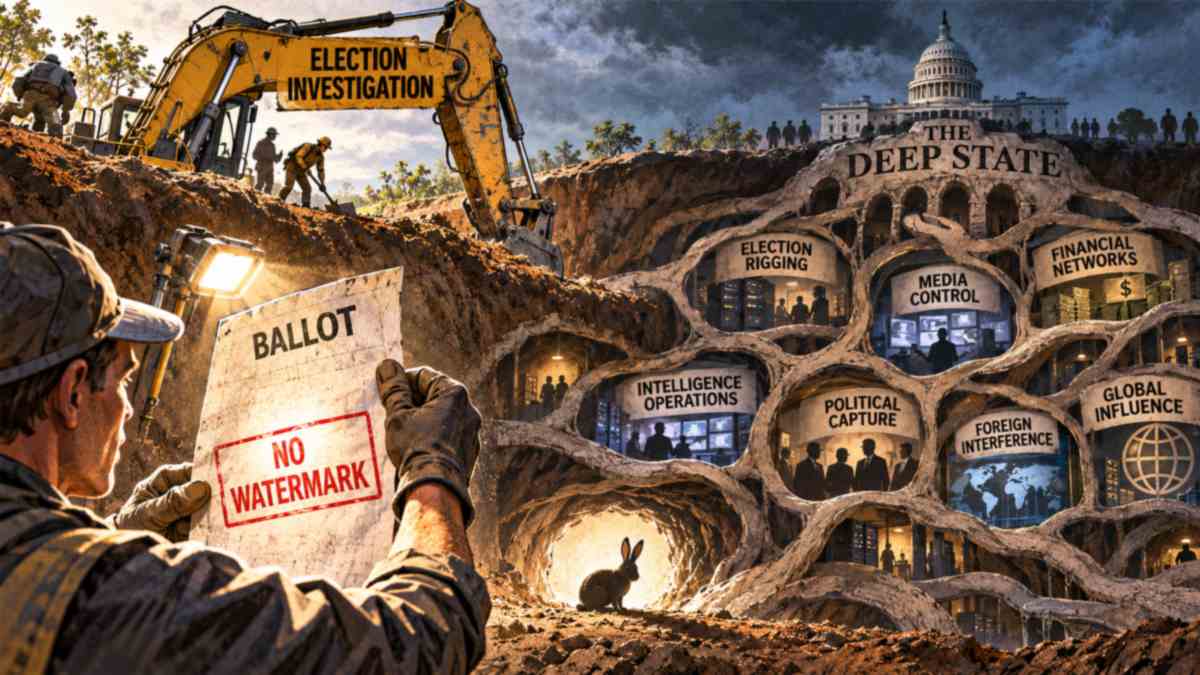
The hypothetical pile of unauthorised ballot papers serves as the entrance to the warren that is about to be excavated and exposed to public view.
The gateway anomaly must be sufficiently large, accessible and independently verifiable that people across political and cultural divides can recognise the same discrepancy without first agreeing about what it ultimately means.
They do not have to accept the entire rabbit hole. They only have to acknowledge that there is a hole.
This also creates an opportunity for social validation. People can discover that others are seeing the same problem and asking similar questions. Doubt becomes less isolating. Investigation becomes socially possible.
The critical achievement is not immediate agreement about the perpetrators. It is permission to question the official account.
From doubt to discovery
The moment we begin “joining the dots” into a theory of organised corruption, and then “aligning the paths” into a conceptual Deep State, we introduce additional opportunities for counter-claims, alternative explanations and ideological resistance.
This is unavoidable in any serious investigation. But it may be disastrous as the opening move of a mass public awakening.
The initial discrepancy must be capable of standing on its own.
“Fake paper ballots”, if demonstrated, would raise an urgent question about electoral integrity. The public could examine that question without having to agree in advance about who organised the fraud, whether intelligence agencies were involved, or how far the corruption extended.
The distinction between evidence and explanation is essential.
The former establishes that something happened. The latter attempts to explain how and why. Conflating them makes the entire inquiry vulnerable to attack at its most speculative point. Separating them allows the evidence to do its work before people are asked to consider the wider implications.
This is where the psychological architecture becomes especially interesting.
Suppose the public is shown credible physical evidence of a major electoral irregularity. Some people will immediately recognise the implications. Others will look for innocent explanations. Still others will initially reject the evidence because it conflicts with their political commitments.
The strategically important audience may be those in the middle: people who are not deeply invested in either the establishment narrative or the alternative explanation, but who retain sufficient intellectual independence to reconsider their assumptions.
In the context of a possible “Trump is a dictator” media narrative, such people might otherwise be persuaded that extraordinary resistance to the administration is justified. An independently verifiable electoral discrepancy could introduce enough uncertainty to make them reconsider that position.
They need not become Trump supporters. They need only become less certain that the story they have been told is complete.
The battle is not necessarily over which belief people adopt. It is over whether observable reality is permitted to challenge a narrative when the two come into conflict.
The first revelation creates a crack in the explanatory system.
What happens next depends on whether people choose to investigate.
The architecture of belief revision
Once someone has accepted that one important part of the official account may be wrong, other questions become psychologically available.
The desire to investigate voting machines, voter rolls, election administration and the relationships between political institutions may follow naturally from the initial anomaly.
But the sequence matters.
People need a sense of agency and autonomy in discovering the implications for themselves. They must be able to identify their conclusions as their own beliefs, reached through their own investigation, rather than positions imposed upon them by a new authority.
Otherwise, one narrative has merely been substituted for another.
This is the distinction between telling people what to think and enabling them to reconsider how they know what they know. In commercial language, it resembles a “land and expand” strategy. Establish one small but consequential change of mind, then allow the natural implications to unfold.
If an election was rigged, who rigged it?
What power were they seeking, and for what purpose?
How long might the operation have continued, and what other elections warrant investigation?
What decisions were taken by officeholders whose democratic legitimacy may have been compromised?
What institutions, financial arrangements and enforcement mechanisms might have been constructed or captured to preserve that power?
And if the evidence eventually points beyond individual politicians towards a durable structure of hidden influence, how should that structure be understood?
These questions do not all have to be answered at once. Indeed, they should not be.
Each answer needs to establish the basis for the next question. Each proposed connection must remain open to scrutiny, including the possibility that it proves mistaken.
The objective is not to force everyone towards a predetermined conclusion. It is to make inquiry possible where previously it was psychologically or socially prohibited.
This is why propaganda need not always deny inconvenient facts outright. It can be enough to stigmatise the act of asking questions, associate inquiry with disreputable groups, or make the social cost of investigation prohibitively high.
A successful exposure process must overcome those barriers without reproducing them in reverse.
It must allow people to investigate without first demanding their allegiance.
Why the whole rabbit hole cannot be revealed at once
There is a difference between revealing a hidden structure and creating the cognitive capacity to perceive it.
This may be the most important distinction of all.
A constitutional restoration government can publish documents, disclose intelligence, prosecute criminals and present forensic evidence. But none of those actions automatically produces a population capable of integrating the revelations into a coherent understanding of how society has been governed.
The coercive force of the state might be used to arrest those proven to have participated in organised electoral fraud. That would address an immediate criminal problem. It would not necessarily establish the conditions for a stable society afterwards.
Indeed, mass arrests conducted before the public understands the evidence could be interpreted as political repression, regardless of the underlying legal justification.
This is especially dangerous if the alleged misconduct extends into institutions that the population has been conditioned to regard as authoritative and legitimate.
There is therefore a second problem beyond criminal accountability: the reconstruction of public understanding.
People must be able to move from recognising an individual discrepancy, to investigating connected misconduct, to considering whether a larger organising structure exists.
This process has a natural sequencing and pacing imposed by the limits of human belief revision.
Too little evidence, and the anomaly is dismissed.
Too much interpretation, and the audience recoils.
Too rapid a revelation, and the resulting disorientation may produce social instability rather than understanding.
The art of an exposure operation, if that is indeed what we are witnessing, would lie in selecting revelations that are not merely true and consequential, but psychologically absorbable in the order presented.
It is not enough for the evidence to exist. It must become collectively intelligible.
Excavating the warren
This brings us back to the mid-term elections and the possibility of physical ballot authentication.
The legal and forensic issues may ultimately focus on voting machines, voter rolls, electronic records, administrative procedures and chains of custody.
But the psychological gateway might be something much simpler: a physical object whose independently established properties contradict what the public has been told.
Such a revelation would not, by itself, prove the existence of a global criminal power structure. It would not identify every perpetrator or establish the history of any alleged conspiracy.
Its significance would be that it creates a legitimate starting point for further inquiry.
The first discovery need not contain the entire explanation. It only needs to make the next question worth asking.
That is how the rabbit hole becomes accessible to people who would never voluntarily have entered it.
For those of us who have spent years exploring the warren, the temptation is to show everyone the map. We want to explain every tunnel, connection and hidden chamber, and tell people where the passages ultimately lead.
But a map of a place someone does not believe exists is unlikely to persuade them.
They need to see the entrance for themselves.
If there is a coordinated operation to expose a hidden power structure, its greatest sophistication may therefore lie not in the scale of its evidence, but in the order of its disclosure.
The first revelation need not be the largest, most shocking or most consequential.
It needs to be the one that makes the next question unavoidable.
The rabbit hole cannot simply be explained to a population that does not believe it is real. It has to be excavated in public, beginning with something everyone can see.
Source: https://newsletter.martingeddes.com/p/excavating-the-rabbit-hole