The official story of the American railroad is one of the greatest achievements in human history. Thousands of miles of track, laid across mountains, deserts, and rivers by immigrant laborers working with pickaxes and dynamite in the mid-1800s.
It’s an inspiring story. It’s also impossible.
The Transcontinental Railroad was “completed” in 1869. It stretches 1,912 miles from Omaha, Nebraska to Sacramento, California. Through the Rocky Mountains. Through the Sierra Nevada. Through some of the most brutal terrain on the planet.
They tell you it was built in 6 years. By hand. With black powder and sledgehammers.
Let’s do the math.
1,912 miles of track. That’s over 10 million feet of rail. Each rail had to be forged, transported, and laid on wooden ties that also had to be cut, treated, and placed. The roadbed had to be graded. Bridges had to be built. Tunnels had to be blasted through solid granite.
To complete this in 6 years, crews would have needed to lay nearly a mile of finished track PER DAY — including grading, bridging, tunneling, and rail-laying — through mountains, in winter, with 1860s technology.
Modern railroad construction, with diesel equipment, GPS surveying, and prefabricated components, averages about 0.5 miles per day on FLAT terrain.
They want you to believe that 1860s laborers with hand tools were TWICE as fast as modern machines. On mountains.
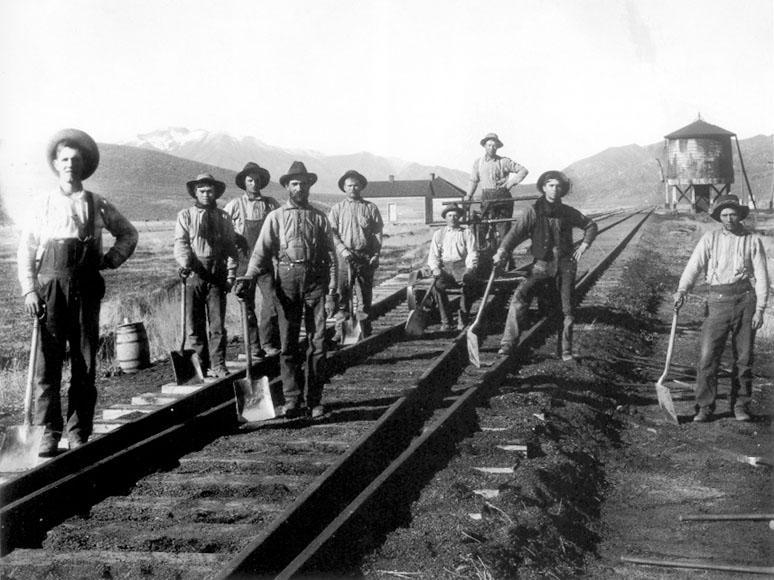
Now look at the old photographs of the “construction.” What do you see? Crews standing NEXT TO already-completed track. Crews “working” on sections that appear to already be graded and prepared. Ceremonial photos of the “last spike” being driven — but no photos of the actual construction process.
What if the railroads weren’t built in the 1860s? What if they were ALREADY THERE?
What if the previous civilization — the one that built the impossible cathedrals and the empty cities — had already laid a continental rail network? And what if the “construction crews” of the 1860s were actually REPAIR crews, reconnecting and restoring a system that already existed?
This would explain the impossible timeline. This would explain why the rail routes follow paths of least resistance that would require aerial surveying to identify — surveying technology that didn’t officially exist until the 1900s.
The railroads weren’t built. They were CLAIMED.
📷 Search “Transcontinental Railroad construction photos.” Look at what’s actually being shown. Then do the math yourself.